Wait it's always π? Always has been
On a beautiful morning in 1650, this guy named Pietro Mengoli:
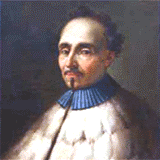
woke up in his mansion. Upon waking up, he realized the pillow case on his square pillow was inverted, as was his wife's, as were his children's, as was his dog's, and as was his cat's.1
Naturally, he then wondered "What is the sum of the inverse squares?"
i.e. What is
i.e. what the hell is the value of:
(jokes aside he's lowk a pioneer)
This is also known as The Basel Problem.
For the next 84 years, many have tried, all have failed to find and prove the exact sum. Until Euler decided to mog everyone in 1734 at 28 years old.
", duh" he said, and everyone was like "bru what".
Euler, being the clever boy he is, noticed that the sine function has zeros at:
And since polynomial can be expressed as a product of factors based on its roots2, e.g. :
Euler treated as one with roots at all these multiples of :
where is some constant.
Since all roots come in pairs: , , and so on, we can group them:
If you multiply all these terms, the product of all is absorbed into the constant .
Thus, we can rewrite the product as3:
Using product notation:
Now take the limit as :
LHS:
RHS:
Hence,
Finally,
Suppose we have a finite product of linear factors:
When expanded, each term comes from choosing either or from each parenthesis.
So:
- The constant term comes from choosing all 1’s.
- The coefficient of comes from choosing exactly one .
- The coefficient of comes from choosing two of them ().4
- And so on.
Formally, the expansion looks like:
Now, Euler’s product is
Each factor contains , so the the coefficient comes from choosing one of the terms (and 1 from all others). There are ways to do this.
Thus, the coefficient of is:
Letting , we get: 5
From basic calculus, we know the Taylor expansion:
Both sides represent the same function, so the coefficients of must be equal:
Multiply both sides by :

This might have been the dumbest proof and post I've ever written. I hope you enjoyed it nonetheless. I will be writing about famous math problems to learn myself, and during the process, the unfamiliar topics involved will invoke posts themselves (Marked To be learned at the footnotes). So the posts will grow exponentially. This way I enjoy learning and you get to read brain rot math. Win-win.
The next post will sort of be a continuation of this one, where I will explore more about the Riemann zeta function and one of the famous millennium problems. This will not be rigorous at all, or else I'll just go earn the million myself.